Jul 15, 2015

Cellphone Operative Systems

All along the years, many companies have developed operating systems (OS) which instead of being for computers, they were made for cellphones. The next text is a brief explanation of the main aspects of them.

Symbian

It was the first operating system developed for cellphones. It was programmed on Java, by Symbian Ltc. It was launched to public in 1998. The fact that it allowed creating your own Java applications and run them successfully on the OS made it famous quickly. We could consider it the grandfather of all cellphone OS. It is open-source. The license for publishing applications for this OS is completely free. However, it was discontinued in 2012. Therefore, it is no longer posible to publish applications for it. It is considered to be an OS for developers and common users. There were 12 versions of it, ending in Symbian OS 10.1.

Android

Android is an OS based on Linux Kernel currently developed by Google. The first version was released in 2007. It is open-source, it is developed in secret by Google and then released publicly in versions allowing modifications and redistribution. However, the license doesn't grant rights to the "Android" trademark. Therefore, device manufacturers must get an individual license from Google. There were a total of 11 versions, some having updates. They are named after food.

It is considered to be for developers, businessmen and common users. To publish an application on the store for Android, you must pay 19.22€ for the license, which lasts a lifetime. The validation process takes around 5 to 30 minutes. According to some surveys, for the end of 2013, Android occupied 78% of the market.

IOS

It is a mobile OS developed by Apple Inc., exclusively for Apple products. It was first released in 2007 and since then there have been a lot of versions released, because it is not only for cellphones but for other devices too. It is closed-source. Apple Inc. considers it is for professionals and common users. In order to publish an application on the store for iOS, you need to pay 80€ every year, and you must wait 1 week in average for it to be validated. The validation process is long and very strict. According to some surveys, in 2012 it covered the 21% of the smartphone mobile operating system units.

Windows Phone

Windows Phone is an OS developed by Microsoft. It was released in 2010 and there are a total of 4 versions, with not more than 2 updates each. It should be friendly for people who know how to use Windows 8 for PCs due to its similar interface. It is supposed to be for developers and common users. It is closed-source. If you want to publish an application in its store, you must pay 80€ anually. The fact that both, iOS and Windows Phone, have this price for applications, gave Android a huge advantage. Moreover, the validation process is very strict and it takes from 1 to 2 weeks.


BlackBerry OS

It is an operating system developed by BlackBerry Ltd. for its BlackBerry smartphones. It is closed-source, it was released in 2000. There have been 7 versions. It is an operating system for professional, business and common use. The license to publish applications in its store is free. However, the validation process is long and very strict, lasting from 1 to 3 weeks. You need a special phone service, as BlackBerry Ltd. works in conjunction with the phone companies. It is estimated that it covers only 2% of the market.

Firefox OS

It is an open-source OS based on Linux Kernel. The developer is Mozilla. It was released in 2013. It is supposed to be for developers, users with low resources, amateurs and common users. It hasn't been developed too much, and it is unknown how many users own a device with Firefox OS. There are only Firefox OS 1 and Firefox OS 2, but with many updates each. Although the validation process for uploading applications is slow, there are no restrictions. Furthermore, the license to publish the applications in the store is free. The browser used in cellphones with Firefox OS should be Mozilla Firefox.

Tizen OS

Tizen is an operating system developed by Linux Foundation and it has the support from Intel, Samsung and Limo. It was launched to public in 2012, and there are 3 versions in total. It is easy to programme applications for this OS. The licenses to publish applications is free and the validation process is flexible. The OS is open-source and it is meant to be for developers and common users. As well as many other operating systems, it is based on Linux Kernel. It targets a wide variety of devices, such as smartphones, smart TVs, PCs and even smart home appliances like a washing machine.

Ubuntu Phone

Ubuntu Touch, also known as Ubuntu Phone is the mobile version of Ubuntu for PCs. It is developed by Canonical UK Ltd and the Ubuntu Community. It is for devices with a touchscreen, like smartphones and tablets. It was originally developed for the Nexus 4, 5 and 6. It tries to be as similar as possible to the Ubuntu for computers. The licenses to upload applications into the store and the validation process is completely free and with no restrictions. Therefore, they are uploaded in seconds. The OS is open-source. There's only one version, Ubuntu OS, released in 2013. It is supposed to be for developers and common users.

Brew MP


It is an operating system developed by Qualcomm. It is for normal cellphones, not smartphones. There are 2 versions, B.R.E.W. and Brew MP. It is open-source. The licenses to upload applications into the store is free, and the duration of the process of validation depends on the region. Brew MP. was released in 2010. It is mainly for common users.

For further information, you can click in one of the following links: Ubuntu Phone, Brew, Tizen (2), Firefox OS, BlackBerry OS, Windows Phone (2), iOS (2), Android (2), Symbian. operating system, software licenses, mobile operative systems (spanish).

Sources

Jul 8, 2015

PC Operating Systems

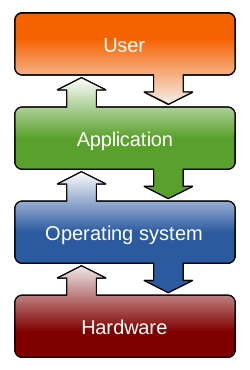
   Operating systems (OS) are a part of software that manage computer hardware and software resources and provide common services for computer programs. The operating system is an essential component of the system software in a computer system. Programs usually need an operating system to work correctly. There are 3 main operating systems for personal computers (PC).

Mac OS X Yosemite

   Mac OS X Yosemite is the latest release of OS X. It was developed by Apple Inc. and released to consumers on October 16, 2014. Its latest version is the 10.10.4, which dates back from June 30, 2015.

   Mac OS come pre-installed in Apple products. However, they are designed to work efficiently on the last one, or a new one. Therefore, Mac OS won't work on old Macintosh computers. For example, Mac OS X Yosemite only works on 7 models.

   All Mac OS are free and are closed-source, but have some open-source components. That's why, to get this operating system, you must buy an Apple product which has it installed. 

Windows 10

   Windows 10 is a PC operating system developed by Microsoft. It was announced in September 2014, and it became available to general public in July 29, 2015. Its predecessor is Windows 8.1, an update of Windows 8. Microsoft announced that Windows 10 would be free of charge to people with a genuine license of Windows 7 and 8, for the first year, in order to encourage its adoption.

   The aim of Windows 10, according to Microsoft, is to unify the Windows operating system across different kinds of Microsoft devices, such as smartphones, PCs, tablets and more. It has introduced some new things, like a new default browser, named Microsoft Edge which replaces Internet Explorer. Microsoft also took into account the revisions of previous OS. Therefore, it added a Start Menu similar to Windows 7 but it kept the live tiles, as well as many other things from Windows 8 and other previous OS.

   Windows 10 can be installed in personal computers, and it doesn't come pre-installed. That means that, in opposition to Mac OS X Yosemite, you buy the license from Microsoft to use the OS and install it in a computer, instead of having to buy a device which already comes with the OS pre-installed.

   This OS is not free unless you match the conditions above. Due to the existance of 4 different editions of Windows 10 (Home, Pro, Education and Enterprise), the prices may vary significantly. It is unnecessary to say that Windows 10, just like the predecessors, is closed-source.

GNU/Linux

   Linux is an operative system released on 1991, based on Linux kernel, developed by Linus Torvalds. It is free and open-source, as well as its development and distribution. Even though it's the biggest open-source operating system, it is used only on around 1.5% of desktop computers.

   Unlike Windows and Mac OS, Linux doesn't have versions or updates. However, some companies or people from the community develop, modify and distribute Linux with this editions. Some of the most popular are Linux Mint, Ubuntu and openSUSE. It has attracted developers since it came out, because it is open-source. It consumes a low amount of resources, which makes a processor be more efficient than with other OS, such as Windows.

The community contributes to develop this operating system, and there isn't a version of Linux which is released with updates and modifications. Each user can freely modify it as it is based on Linux Kernel. This means that there isn't a standard GNU/Linux OS version, but hundreds and hundreds of them.

For further information, you can click in one of the following links: Mac OS X Yosemite, Linux, Windows 10, Apple Inc., Microsoft, Linus Torvalds, operating system, software licenses.

Sources

Jul 1, 2015

Software Licenses

   A software license is a legal instrument governing the use or redistribution of software. It is a contract between the owner of the software and the user of it. A software are all the programs and other operating information used by a computer. There are many kind of softwares licenses, which can be classified in two ways according to the terms of distribution. Almost all of them include a software copyright, either for preventing unauthorized copy of the software, or to enforce their terms.


Free Open-source Software Licenses

   This software licenses allow modifying and editing the software. There are 2 categories:

  • Permissive licenses: They try to keep to the minimum the restrictions about the redistribution of the software. Some examples are the MIT license and the BSD license.
  • Copyleft licenses: They aim to preserve maximum freedom. They give unlimited permission to use, study, modify and redistribute the software or any modifications of it, as long as any subsequent users also have this rights.
Proprietary Software Licenses

   In this kind of software licenses, the publisher grants the use of the software under an end-user license agreement, but he keeps the ownership of it. This way, some rights are kept to the publisher. They often include terms of use, which define important things about the use of the software, such as the numer of installations allowed and the terms of distribution. Therefore, if the end-user doesn't accept the license, he can't use the software. This kind of software usually includes maintenance in the agreement. 
   The proprietary software licenses are almost always closed softwares. This means that is restricted to edit, modify, test and do other activities which are included in the license. A well-known example of this kind of proprietary software licenses is Microsoft Windows.

To get more information about the different type of licenses, click here. For specific information about free software licenses, click here. If you wish to know more information about open-source software licenses, click here. For extra information on proprietary software licenses, click here.

Sources